By the BossCE Editorial Team.
Key Points
- BossCE AI Academy gives you a realistic clinical case, marks your written reasoning against the learning objectives and current guidance, and then asks two viva questions.
- Every attempt brings a new patient, at medical or dental, undergraduate or postgraduate level, across 106 topics at launch, and 285 today.
- You can share your case and score with a colleague in one tap. They get the exact same case, not your answer, and can try to beat you.
Try This Case Before You Read On
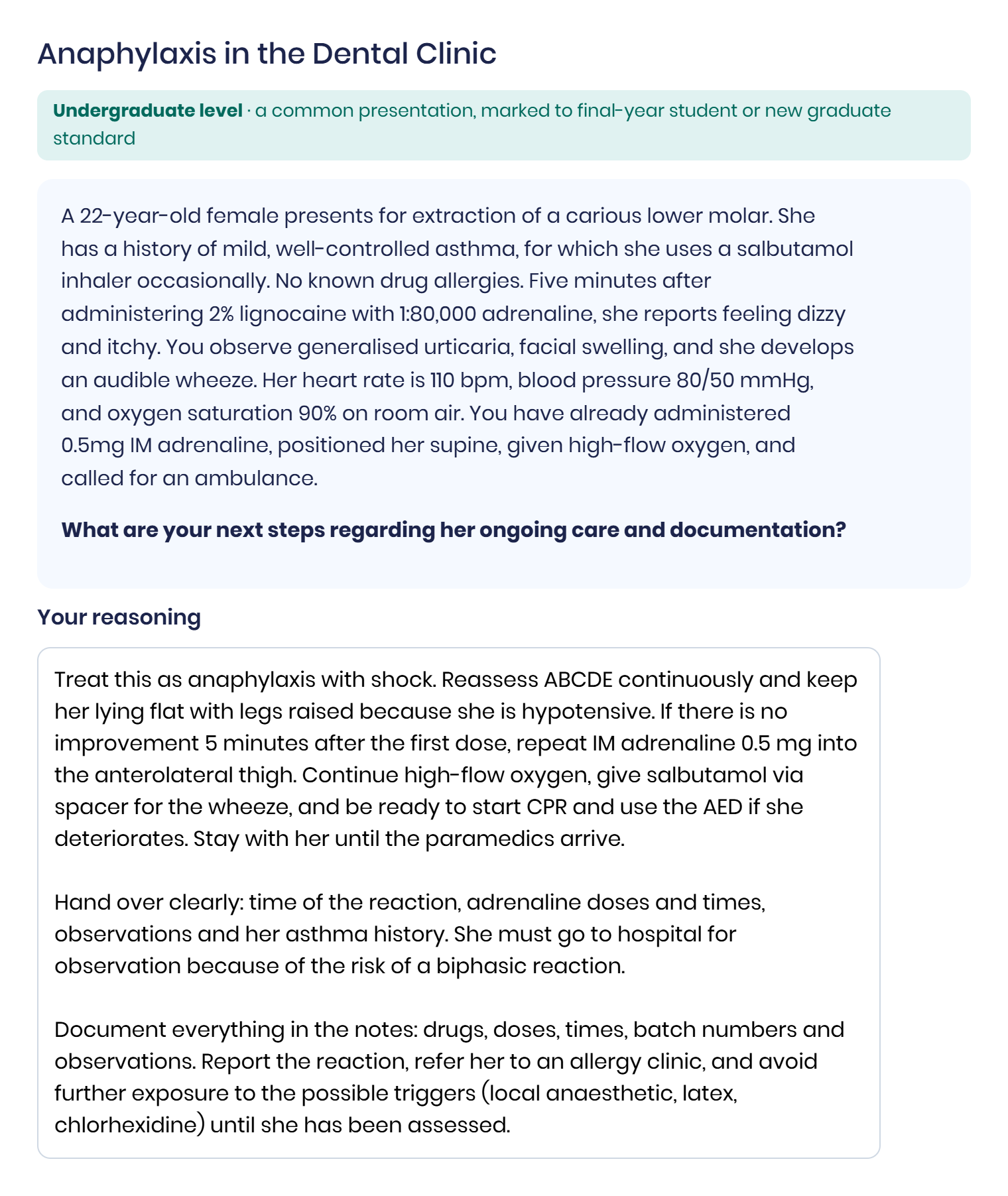
A 22-year-old woman is in your dental chair for an extraction. Five minutes after local anaesthetic she feels dizzy and itchy. You see generalised urticaria and facial swelling, and she starts to wheeze. Heart rate 110, blood pressure 80/50, oxygen saturation 90% on air. You have already given 0.5 mg IM adrenaline, laid her flat, started high-flow oxygen and called an ambulance.
What are your next steps for her ongoing care and documentation?
Take ten seconds and list them in your head. We wrote our answer in the Academy and scored 3 out of 5. Here is what happened, and how you can try the same case yourself.
Step 1: Read the Case and Write Your Reasoning
Open Academy, choose your level and pick a topic. BossCE AI writes a short case pitched at that level, set where you actually work, with you as the treating clinician. You write what you would do and why, in your own words. There are no multiple-choice options to guess from.
Step 2: Get Marked Against the Evidence
Press Check my reasoning. Within a minute you get a score out of 5 and structured feedback: what you got right, what you missed or got wrong, a numbered model answer and the sources behind it.
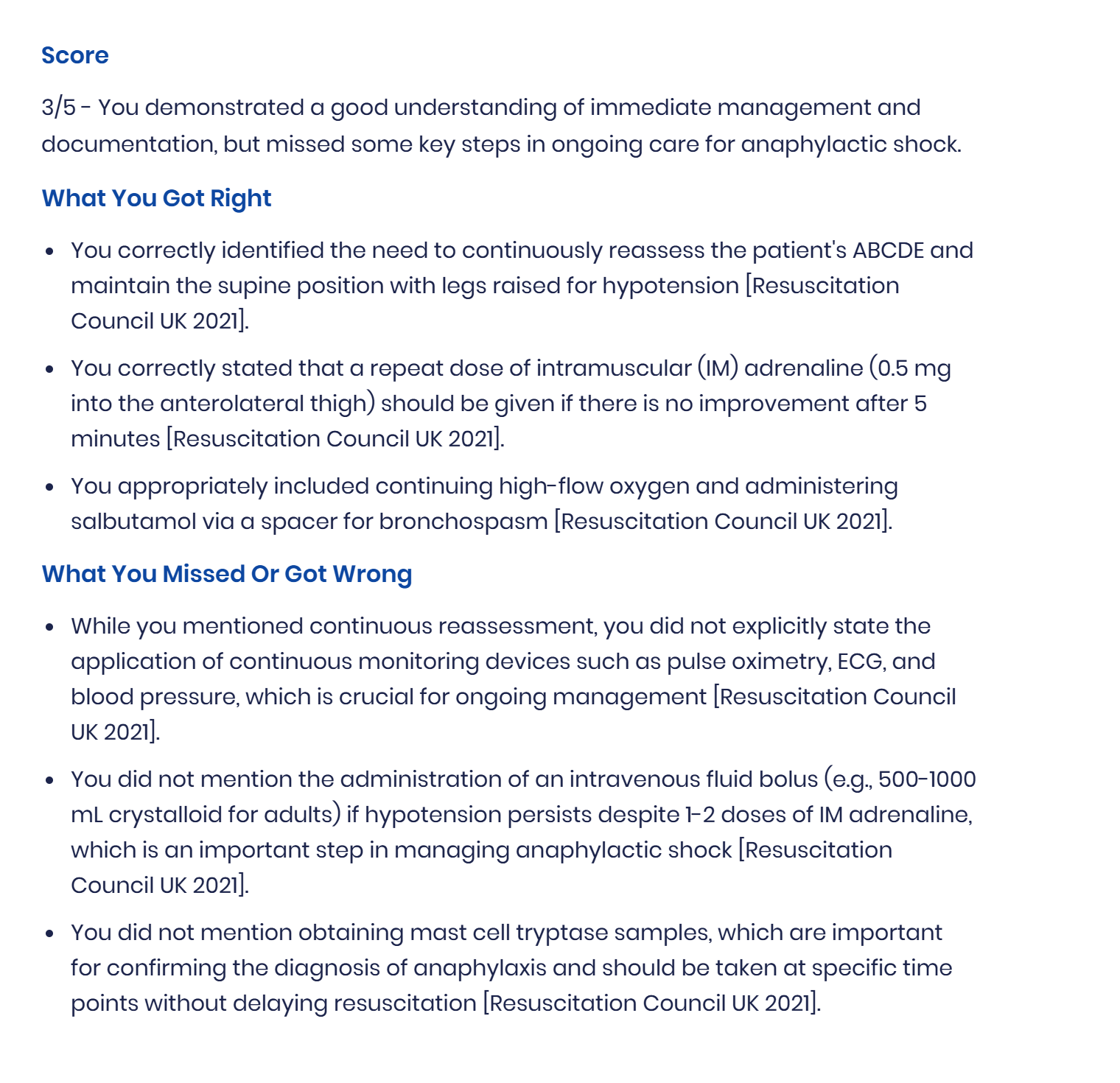
Our answer covered the essentials: reassess ABCDE, repeat IM adrenaline after 5 minutes if there is no improvement, keep oxygen running, treat the wheeze, hand over clearly and send her to hospital for observation. We lost marks for three things the Resuscitation Council UK guideline expects [1]:
- Monitoring: pulse oximetry, non-invasive blood pressure and ECG as soon as possible.
- Fluids: a rapid IV fluid bolus of 500 to 1,000 mL in an adult whose shock persists.
- Mast cell tryptase: samples ideally within 2 hours of onset, to help confirm the diagnosis later.
In a dental clinic, the last two are usually started by the paramedics or the hospital team. Knowing they are coming, and handing over the timings that make tryptase useful, is still part of good care. That is the kind of gap the Academy is designed to show you.
Step 3: Answer the Viva Questions
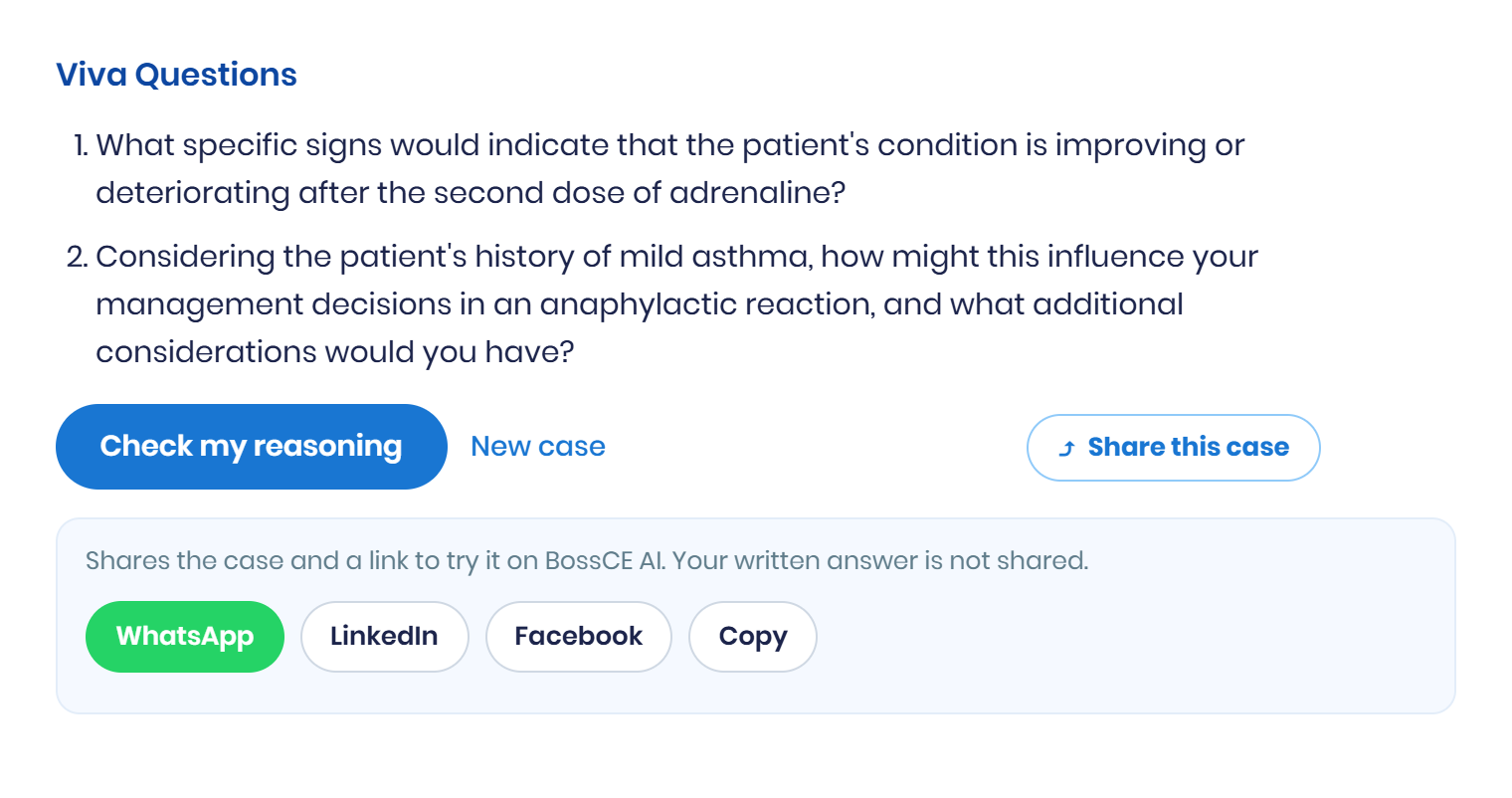
The Academy then asks two viva questions that test your reasoning, not your memory of a document. For this case: what signs would show she is improving or deteriorating after the second dose of adrenaline, and how does her asthma change your management?
Step 4: Challenge a Colleague
This is where the Academy gets competitive. Press Share this case and send it to WhatsApp, LinkedIn or Facebook, or copy it into any chat. Your colleague receives the case, your score and the viva questions, with a link that opens the same patient in the Academy.
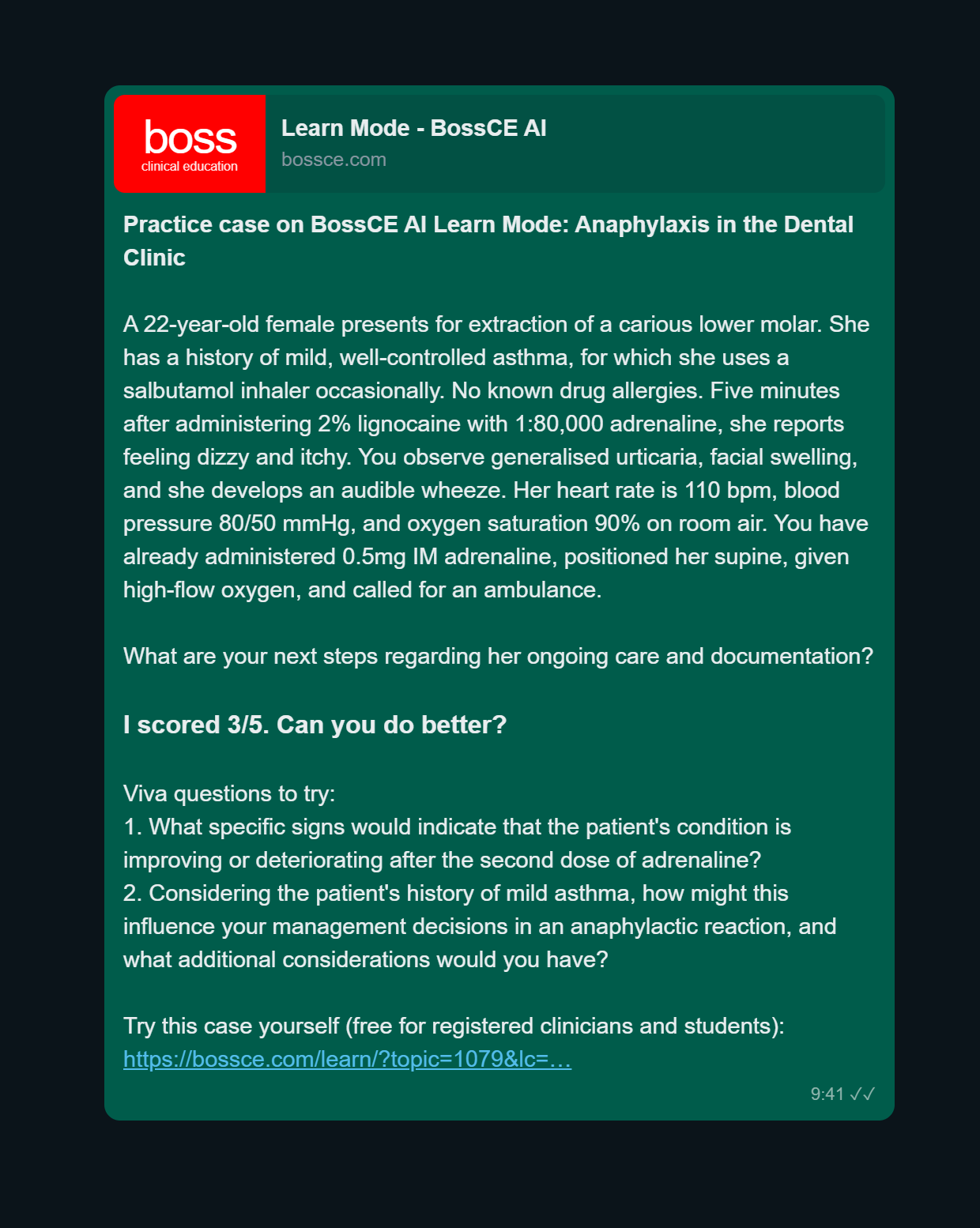
- Your written answer is never shared. Only the case, your score and the viva questions.
- The link opens the exact case. Everyone answers the same patient, so scores can be compared fairly.
- Nothing is stored. BossCE does not store the case text or your answer; the case travels inside the link.
It works well in a study group, a department chat or a WhatsApp group of classmates preparing for finals or membership exams. One case, ten answers, and a good discussion about who missed what.
What Else to Know
- Four levels: Medical Undergraduate, Medical Postgraduate, Dental Undergraduate and Dental Postgraduate. Postgraduate cases are harder and are marked to specialty-trainee standard.
- A new case every time: press New case for a different patient on the same topic.
- Global marking: any current recognised guideline is accepted, and national guidance is mentioned only where it differs.
- Daily questions: each marking uses one of your daily BossCE AI questions. Writing a case and opening a shared case are free.
- For lecturers: run the Academy with your own class, using a join code, the same case for everyone and a downloadable class report. Request free lecturer access.
Can You Beat 3/5?
Open the same anaphylaxis case we answered, write your reasoning and see your score. It is free for registered clinicians and students.
Prefer to start fresh? Pick any Academy topic. New to BossCE? Register free in under a minute.
Sources
- Resuscitation Council UK. Emergency treatment of anaphylaxis: guidelines for healthcare providers. May 2021.
This article is for qualified healthcare professionals and is not a substitute for clinical judgement or the full guideline. Check the current version of each source before applying it.